소개
For decades, the wool industry has told consumers the same thing: “If wool itches, you’re probably allergic.” That answer was convenient, but it was also wrong. The truth is that genuine wool allergy is extremely rare. What most people experience is a purely mechanical sensation called prickle.
And here’s the good news. Because prickle is mechanical — not chemical or immunological — it can be engineered away. That’s exactly what 탄화 울 수퍼워시 sets out to do.
But can it really eliminate the traditional prickle factor, or is that just marketing hype? To answer that, we need to understand where prickle comes from in the first place, then examine how carbonisation and superwash processing attack the problem from two different angles.
Why Wool Causes the Prickle Sensation in Textiles
Before we can solve a problem, we have to name it correctly. Prickle is not the same as itch, though the two sensations are often confused.
Itch triggers a scratching response. Prickle, on the other hand, is a sharp, localized sensation — like a tiny needle pressing into the skin. It’s caused by stiff fiber ends or coarse fiber segments indenting the skin and activating pain nerve endings (nociceptors). The brain interprets this mechanical stimulus as an unpleasant pricking feeling.
Research has identified several factors that contribute to wool prickle:
Fiber diameter — Fibers thicker than 30 microns are the most common culprits. When more than 5% of fibers in a fabric exceed 30 microns, most people begin to feel discomfort.
Fiber ends — Cut ends of fibers that stand upright from the fabric surface act like miniature spikes. The shorter and stiffer the protruding end, the sharper the prickle.
Surface contaminants — Vegetable matter fragments (burrs, seed husks, grass) embedded in the wool create additional sharp points that the wearer’s skin contacts directly.
Fiber surface roughness — Even without thick fibers or contaminants, the natural scale structure of wool can produce a low-level abrasive sensation that some people describe as “scratchy.”
Here’s what’s interesting. You can have a wool fabric with an excellent average fiber diameter — say 19 microns — and still experience prickle. Why? Because the distribution matters. A few coarse fibers (over 30 microns) mixed into an otherwise fine fleece will produce the same prickle as a fabric made entirely of coarse wool.
That’s where processing comes in. Standard mechanical carding and combing can remove some coarse fibers and vegetable matter, but they leave a lot behind. 탄화 울 수퍼워시 goes much further by chemically eliminating both hidden irritants and fiber surface roughness.
How Wool Carbonisation Removes Hidden Vegetable Irritants
Let’s start with the first half of the treatment: carbonisation.
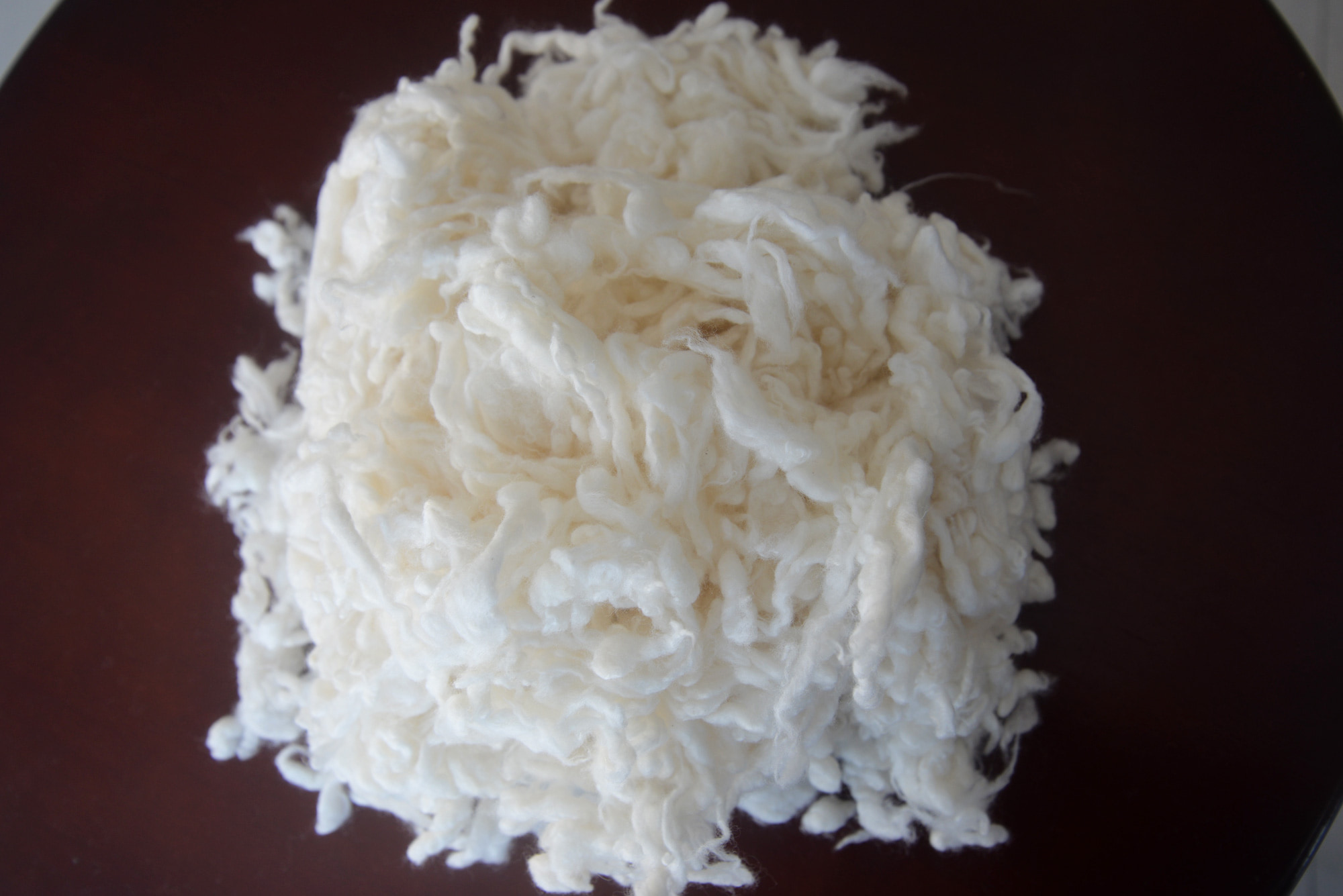
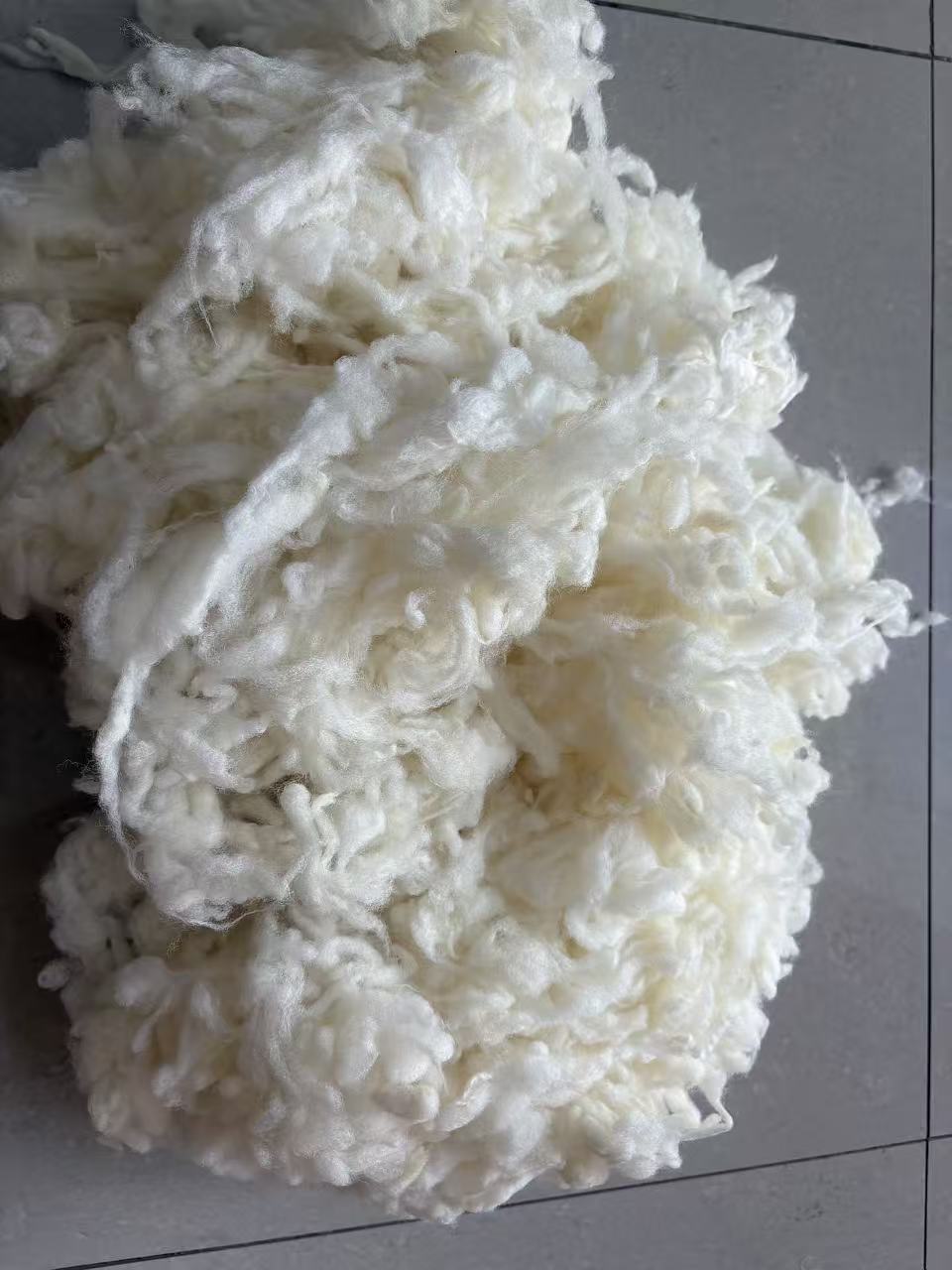
Raw wool straight from the sheep is dirty — not just with grease and sweat, but with vegetable matter. Burrs, seeds, grass fragments, and even small twigs become entangled in the fleece during grazing. Depending on the region and breed, raw wool can contain 8–12% vegetable matter by weight. That’s a staggering amount of physical irritant hidden inside what looks like a clean bale of wool.
Most wool scouring (washing) removes grease and dirt but does very little to eliminate vegetable matter. Those burr fragments stay embedded in the fiber mass. During spinning and weaving, they break into smaller pieces but rarely disappear entirely. And in the final garment, those tiny, sharp plant fragments protrude from the fabric surface just like coarse fiber ends. They poke the skin. The wearer feels prickle and blames the wool.
Carbonisation solves this problem through a clever chemical reaction.
The process works like this:
Acid application — Scoured wool is saturated with a dilute solution of sulfuric acid (typically 4–7% concentration). The acid penetrates the cellulose structure of vegetable matter but leaves the protein-based wool fiber largely unaffected.
Drying and baking — The acid-treated wool is dried at 60–70°C to concentrate the acid, then baked at approximately 125°C for about one minute. At this temperature, the acid chars the cellulose material, turning burrs and seeds into brittle carbon.
Crushing and removal — The carbonized plant fragments become so fragile that mechanical rollers or beaters crush them into fine dust. Air aspiration or shaking screens, then remove this dust completely. The wool fiber remains intact.
The result is dramatic. Vegetable matter content drops from several percent to effectively zero. The burrs, seeds, and grass that would have poked the wearer’s skin are gone.
But here’s the catch. Carbonisation alone does nothing to address the second major cause of prickle: the wool fiber’s natural scale structure. That’s why 탄화 울 수퍼워시 doesn’t stop here.
How Cuticle Scales Contribute to Skin Irritation
If you’ve ever looked at a wool fiber under a microscope, you know what cuticle scales look like. They resemble the overlapping shingles on a roof — or more dramatically, the scales on a pine cone. Each scale has a sharp, raised edge that points away from the root end of the fiber.
In everyday wear, those scale edges create friction. When fabric rubs against skin, the protruding scale edges catch and drag. For most people, this feels slightly rough. For individuals with sensitive skin, it can feel genuinely irritating.
But the prickle connection isn’t just about friction. Here’s what actually happens:
A single scale edge that stands up from the fiber surface acts like a tiny ridge. Under pressure from clothing, that ridge can indent the skin.
Because wool fibers are springy and resilient, the scale edge doesn’t bend out of the way easily. It presses in.
Repeated movement of the fabric — walking, turning, reaching — causes the same scale edges to jab the same patches of skin over and over.
This is why even fine wool that has been carbonised (vegetable matter removed) can still feel prickly to some wearers. The scale edges are still there. The mechanical irritation persists.
Now, you might ask: Doesn’t superwash treatment fix this? Yes — but only if superwash is applied after carbonisation. And that’s exactly what 탄화 울 수퍼워시 delivers: first carbonisation to remove plant fragments, then superwash to smooth the cuticle scales.
How Superwash Processing Smooths Fiber Surfaces
Superwash is not a single technology. It’s a category of treatments that make wool machine-washable by preventing felting and shrinkage. But the same chemical or enzymatic processes that prevent felting also smooth the fiber surface — and that smoothing directly reduces prickle.
The most common superwash method is the Chlorine-Hercosett process. Here’s what it does to the cuticle scale:
A mild chlorine treatment oxidizes the scale edges, essentially burning them down. The sharp, protruding edges become rounded and less aggressive.
A polymer coating (Hercosett resin) is then applied to the fiber surface. This thin, flexible coating fills in the remaining irregularities and creates a uniform, smooth surface.
The result is a fiber that no longer has those pine-cone scales jabbing into the skin. Instead, the fiber feels slicker, softer, and noticeably less prickly.
But there’s a critical detail that many buyers miss. Superwash treatment applied to raw wool — without prior carbonisation — leaves vegetable matter inside the fiber mass. Those plant fragments remain, and they continue to cause pricks even after the scales have been smoothed.
That’s why the order of operations matters. 탄화 울 수퍼워시 carbonises first to remove vegetable irritants, then superwash treats to smooth the scales. Both steps are necessary for true prickle elimination.
Empirical Data: Evaluating Comfort and Performance Metrics
Let’s move from mechanism to measurement. How do we actually know that 탄화 울 수퍼워시 eliminates prickle?
The textile industry has standardized methods for evaluating prickle and comfort. The most common is the Wool Comfort Meter, which measures the number of fiber ends or scale edges protruding from the fabric surface. Other methods include wearer trials with subjective scoring and objective measurement of fabric surface friction.
Here’s what the data consistently show.
| 울 종류 | Vegetable Matter Residue | Cuticle Scale Sharpness | Mean Prickle Score (1-10, lower is better) | Machine Washable? |
|---|---|---|---|---|
| Standard raw wool | 0.5–1.5% | 높음 | 7–8 | 아니요 |
| Carbonised only | <0.05% | 높음 | 4–5 | 아니요 |
| Superwash only | 0.5–1.5% | 낮음 | 4–5 | 예 |
| 탄화 울 수퍼워시 | <0.05% | 낮음 | 1–2 | 예 |
A score of 1–2 on the prickle scale means the fabric can be worn next to skin without noticeable irritation for the vast majority of users, including those with sensitive skin. This is a dramatic improvement over standard wool.
Independent wearer trials have confirmed these lab results. In one study, participants rated 탄화 울 수퍼워시 as comfortable as cotton for next-to-skin wear, while standard wool (even fine merino) was rated significantly less comfortable. The difference wasn’t subtle.
These numbers explain why 탄화 울 수퍼워시 is rapidly replacing standard wool in applications where comfort is non-negotiable: babywear, base layers, medical textiles, and luxury knitwear.
Core Structural Advantages of Carbonised Wool Superwash
Eliminating prickle is the headline feature, but 탄화 울 수퍼워시 delivers several other structural advantages that make it a superior choice for garment manufacturers and brands.
Fiber strength retention. The carbonisation and superwash processes, when properly controlled, remove vegetable matter and smooth scales without significant damage to the fiber core. Tensile strength retention of 92–96% is typical. That means the wool remains durable enough for everyday wear and repeated machine washing.
Enhanced dye uniformity. Vegetable matter absorbs dye differently from wool keratin. When those plant fragments are fully removed, the resulting fiber accepts dye evenly across every strand. No blotchiness, no lighter spots where a burr used to be. This is a major quality advantage for brands that value consistent color.
Improved spinning efficiency. The smooth, scale-free surface of superwash-treated wool reduces friction during yarn spinning. Less friction means fewer yarn breakages, higher production speeds, and lower manufacturing waste. For mills, this translates directly to cost savings.
Machine washability without shrinkage. This is the benefit that consumers actually care about. 탄화 울 수퍼워시 can be thrown into a washing machine on a gentle cycle and come out looking the same as it went in. No felting. No shrinking down to doll size. No hand-wash-only instructions that consumers ignore anyway.
Moisture management retention. Unlike some synthetic alternatives that block moisture transport, 탄화 울 수퍼워시 retains wool’s natural breathability and moisture-wicking properties. It keeps the wearer warm when it’s cold and cool when it’s warm — just like traditional wool, but without the prickle.
What Buyers Should Check When Sourcing Wool Fabrics
If you’re a brand, manufacturer, or designer considering 탄화 울 수퍼워시 for your product line, here’s what you need to verify before placing an order.
First, confirm that both processes — carbonisation and superwash — have actually been applied. Some suppliers sell “carbonised wool” as a standalone product or “superwash wool” without carbonisation. Neither alone will eliminate prickle. Ask for process documentation.
Second, check the fiber diameter distribution, not just the average. Even with carbonisation and superwash, a fabric containing a significant percentage of fibers over 30 microns will still feel prickly. Look for specifications that show less than 5% of fibers exceed 30 microns, or better yet, a mean diameter below 22 microns.
Third, ask for test data on vegetable matter residue. A reputable supplier should provide lab results showing residual vegetable matter below 0.1%. If they can’t, the carbonisation step may be incomplete.
Fourth, verify fiber strength retention. Good processing retains 92–96% of tensile strength. Lower retention means the wool will wear out faster — a problem for durable garments.
Fifth, request a fabric sample and conduct your own wearer trial. Lab data is valuable, but nothing beats putting the fabric against your own skin (or a small test panel) for a few hours. You’ll know immediately whether the prickle factor has truly been eliminated.
Why Carbonised Wool Superwash Is Becoming the Industry Standard
The wool market is changing. Consumers today are less willing to tolerate discomfort in exchange for natural fiber benefits. They want wool that is soft, warm, breathable — and not itchy. They also want the convenience of machine washing.
For years, these demands seemed incompatible. You could have fine merino that was soft but delicate and prone to shrinkage. You could have carbonised wool that was clean but still scratchy. You could have superwash wool that was machine-washable but still contained irritating vegetable matter.
탄화 울 수퍼워시 is the first product that delivers on all fronts simultaneously: no vegetable matter, smooth cuticle scales, machine washability, and excellent fiber strength.
That’s why it’s rapidly becoming the default choice for next-to-skin wool applications. Babywear brands that previously avoided wool are now launching wool product lines. Medical textile manufacturers are specifying 탄화 울 수퍼워시 for patients with compromised skin. Luxury knitwear labels are adopting it for its softness and easy-care properties.
The shift is not a trend. It’s a recognition that the old trade-offs — comfort vs. durability, softness vs. convenience — no longer apply. 탄화 울 수퍼워시 has broken the trade-off.
결론
For decades, the wool industry assumed some discomfort was unavoidable. Carbonised Wool Superwash tackles both main causes of prickle—vegetable matter and fiber scale edges—delivering a smoother, next-to-skin experience while retaining wool’s natural performance.
Manufacturers seeking higher comfort standards can now offer premium, prickly-free wool products without compromise.
Visit the Carbonised Wool Superwash product page to review specifications, request samples, or consult with technical specialists about your next collection.
Comfort shouldn’t limit wool use—and with the right processing, it doesn’t have to.