Wprowadzenie
Raw wełna is transformed into yarn through eight essential mechanical stages – impurity removal, fibre opening, carding, combing (for finer yarns), drafting, twisting, and winding. But before any of that happens, the most critical decision is how aggressively you remove vegetable matter (VM) like burrs, seeds, and straw. If you skip carbonisation or use only basic scouring, those plant fragments remain embedded, causing yarn breakage, uneven dyeing, and abrasive wear on machinery. For manufacturers who want consistent, high-strength yarn with fewer production stoppages, carbonised wełna is not an option – it’s a necessity. This guide walks you through every step, from a dusty fleece to a smooth, ready-to-knit yarn, with special attention to where carbonisation makes the biggest difference.
Step 1: Eliminating What Doesn’t Belong – From Greasy Wool to Clean Fibre
Raw wełna, often called greasy wełna, arrives at the mill carrying more than just fibre. Depending on the region and season, a single kilogram of shorn fleece can contain up to 200 grams of vegetable matter – spiky burrs, grass seeds, and stem pieces that the sheep picked up while grazing. On top of that, there’s lanolin (the natural grease, 10–25% by weight), sweat salts (suint), and dirt. You simply cannot spin this mess.
The first job is impurity removal, or preparation. Mills run the greasy wełna through a series of mechanical openers that tear apart large clumps, allowing heavier dirt to fall out. Then comes scouring: a hot water bath (typically 60–70°C) with detergent and mild alkali that emulsifies the lanolin and dissolves the suint. After rinsing and squeezing, what remains is scoured wełna – clean of grease but still contaminated with VM. For many low-grade applications (carpet underlays, coarse felts), that might be enough. But if you’re spinning yarn for apparel, blankets, or upholstery, those plant fragments are unacceptable.
That’s where carbonisation enters the picture.
Why Carbonised Wool Beats Regular Scouring for VM-Heavy Fleeces
Let me be blunt: scouring alone removes maybe 15% of vegetable matter at best. The rest stays physically trapped among the fibres. Carbonisation, by contrast, chemically destroys the cellulose-based VM while leaving the protein-based wełna intact. The process is surprisingly straightforward:
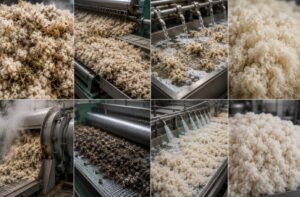
The scoured wełna is dipped in a dilute sulfuric acid bath (typically 4–7% concentration at 60–70°C for 15–30 minutes). Wełna naturally resists acid, but plant material absorbs it readily.
The wet wełna passes through drying chambers, then baking ovens at 100–125°C. The concentrated acid dehydrates the cellulose, turning burrs and seeds into brittle black char.
Mechanical rollers crush that char into fine dust, and vibrating air tables blow the dust away – removing over 98% of the original VM.
Finally, a sodium carbonate wash neutralises any residual acid, followed by a fresh water rinse and final drying.
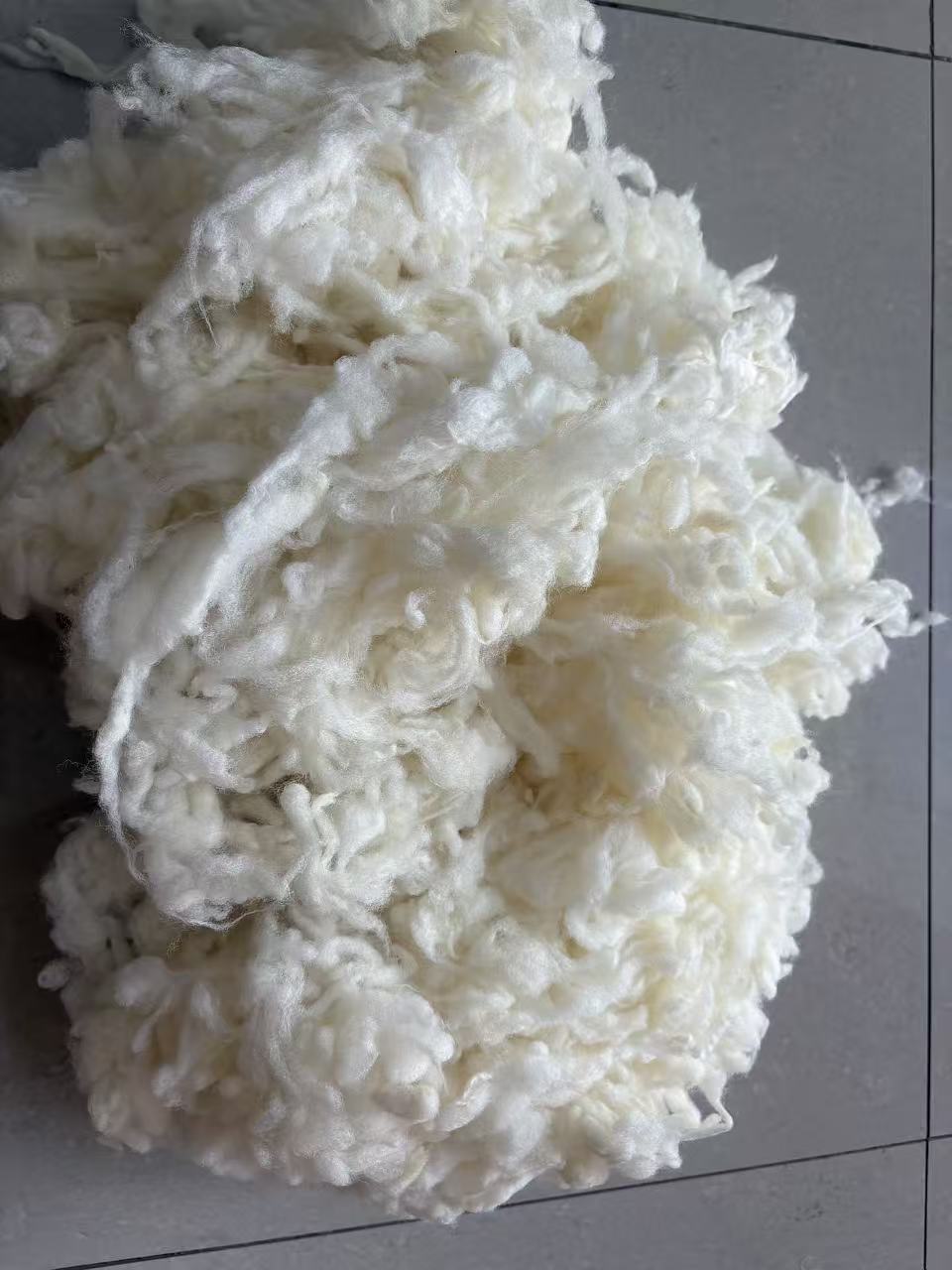
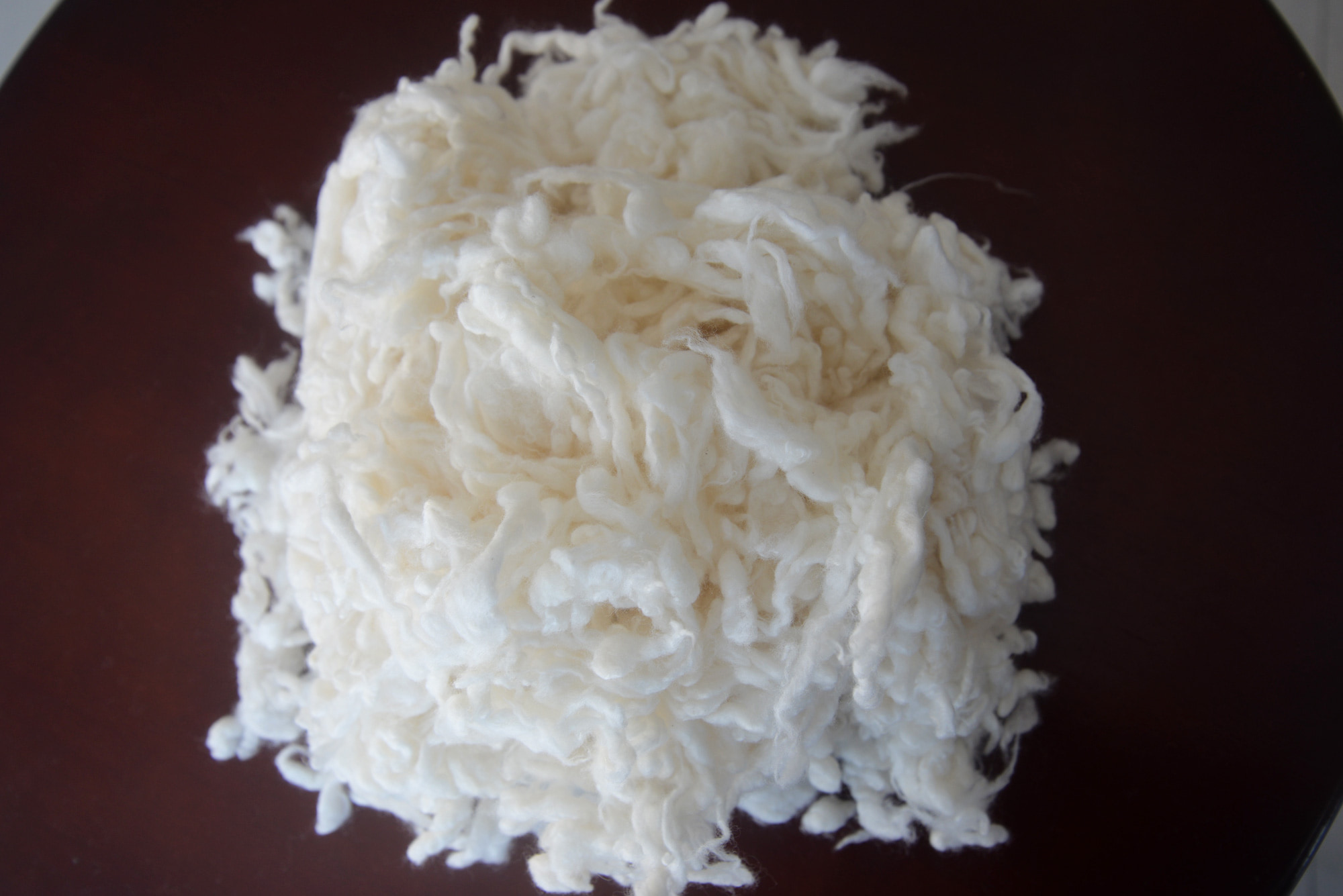
The result? Carbonised wełna is exceptionally clean, with residual VM often below 0.5% by weight. That means fewer yarn breaks, less machine wear, and dye that takes evenly across every centimetre of fabric. Mills that process carbonised wełna report up to 30% fewer spinning interruptions compared to using conventionally scoured but non-carbonised fleece from the same source.
Step 2: Opening and Liberation – Breaking Fibre Clumps Apart
Once the wełna is clean (either scoured or carbonised), it still arrives as compressed, tangled sheets or lumps. The next major stage is opening (also called loosening). Opening machines – like automatic bale openers and multi-blade beaters – tear the compacted wełna into progressively smaller tufts. This isn’t subtle equipment. A typical opener uses rapidly rotating spiked rollers to rip apart clumps that might be as large as a human head. The violence of the process is controlled: you want to separate fibres without cutting them.
Why open the wełna? Three reasons. First, it exposes trapped dust and fine particles so they can be exhausted by air currents. Second, it allows different batches of wełna (varying in colour, fineness, or origin) to begin mixing. Third, and most important, opening creates a loose, uniform mat that can be fed into the carding machine without jamming. If you skip adequate opening, the carding wires will clog within minutes.
Step 3: Carding – Turning Tufts into a Continuous Web
Carding is where wełna starts to look like a proper textile material. A carding machine consists of two large cylinders covered in thousands of fine, angled wire teeth, rotating at slightly different speeds. As the open wełna passes between these cylinders, the teeth comb each fibre, pulling it away from its neighbours and straightening it. The result is a thin, uniform web – a fragile sheet of partially aligned fibres, about the thickness of heavy tissue paper.
For most wełna destined for worsted yarns (fine, smooth, strong), this web is then condensed into a soft, untwisted rope called a sliver. But note: carding alone does not fully parallelise the fibres. Under a microscope, carded wełna still shows many fibres hooked at both ends, and some remain bent or crossed. That’s fine for woollen yarns (bulky, warm, fuzzy), but not for high-count suiting or technical knitwear.
Carded vs. Combed Wool – A Quick Comparison
| Nieruchomość | Carded-only Wool (Woollen yarn) | Carded + Combed Wool (Worsted yarn) |
|---|---|---|
| Fibre arrangement | Random, some hooks | Highly parallel, nearly straight |
| Yarn surface | Hairy, soft | Smooth, crisp |
| Strength | Umiarkowany | High (20–40% stronger) |
| Typical uses | Blankets, hand-knitting, tweeds | Suits, fine socks, technical fabrics |
| Production speed | Faster, less waste | Slower, removes short fibres |
If your goal is a luxury suit or a hard-wearing upholstery fabric, you absolutely need the combing step. If you’re spinning a chunky scarf or a durable carpet, carded-only wełna is perfectly adequate.
Step 4: Combing (For Worsted Yarns) – Perfection Before Spinning
Combing is the refinement step that separates premium wełna from commodity material. A comber is like a series of very precise, narrow combs that grip a small fringe of the carded sliver. One set of combs holds the fibres at their root ends while another set combs through the tips, removing any short fibres (called “noils”) that fall below a set length threshold – typically 25–40mm depending on the target yarn count. The comber also yanks out any remaining VM fragments that somehow survived carbonisation.
What remains is a top – a sliver of long, parallel, clean wełna fibres, all essentially the same length. The short noils are collected and sold separately for lower-grade applications like felt or stuffing. For the spinner, combed wełna is a dream: it drafts evenly, twists without localised weak points, and produces a yarn that resists pilling and abrasion.
How much material is lost as noils? That depends on the original wełna quality. Fine Merino wełna (average fibre length ~70mm) might lose 15–20% to noils. Short-stapled crossbred wełna might lose 30% or more. That waste is expensive, but the resulting worsted yarn commands a much higher price per kilogram.
Step 5: Drawing and Drafting – Stretching the Sliver to the Right Thickness
At this stage, you have a sliver (or top) that might be as thick as your thumb. A typical worsted yarn, however, is thinner than a sewing thread. You cannot go from thumb-thickness to thread-thickness in one pull – the fibres would simply break. So mills use a series of drafting frames, usually three to five in sequence.
Each drafting frame consists of pairs of rollers turning at different speeds. The back rollers feed wełna at a slow rate; the front rollers pull it away faster, stretching the sliver. The ratio between front and back roller speeds is the draft. A typical first draft might be 6:1, turning a 12-gram-per-metre sliver into a 2-gram-per-metre roving. After three or four drafting passes, the roving becomes as fine as heavy string.
During drafting, the wełna fibres slide past one another. Because they are now parallel and (in combed slivers) all roughly the same length, they slide smoothly without excessive variation. But uneven drafting – caused by worn rollers, inconsistent sliver input, or static electricity – creates thick and thin places in the roving. Those imperfections will become permanent weak spots after twisting. That’s why modern mills use auto-levellers that monitor sliver thickness and adjust roller speeds hundreds of times per second.
Step 6: Twisting – Giving Yarn Its Strength and Character
Drafting produces a roving – a loose, untwisted strand that has almost no tensile strength. You could pull it apart with your fingers. Twisting changes everything.
Twisting is simply rotating the roving around its own axis. As it twists, the parallel wełna fibres take on a helical path, pressing inward against each other. This radial pressure creates friction between fibres, and that friction resists being pulled apart. The more twists per metre (or per inch), the stronger the yarn – up to a point. Over-twisting makes the yarn stiff, snarled, and prone to kinking.
There are three main twisting methods:
Ring spinning: The roving passes through a traveller that orbits around a stationary ring. This is the most common method for high-quality wełna yarns. Speeds are moderate (15–25 metres per minute), but the yarn has excellent uniformity and strength.
Open-end (rotor) spinning: The fibres are fed into a fast-spinning rotor where centrifugal force wraps them together. Much faster (150+ m/min), but the yarn is coarser and less even – fine for denim or workwear, not for premium wełna.
Air-jet spinning: High-pressure air twists the fibre bundle. Extremely fast but works best with synthetic blends. Pure wełna can be air-jet spun only if it is very long and clean.
For worsted wełna yarns, typical twist levels range from 400 to 900 twists per metre, depending on the intended use. A soft, drapey scarf might use 400 TPM; a hard-wearing sock yarn might use 700 TPM.
A Real-World Twist Example
Imagine two worsted yarns, both made from the same carbonised wełna top. Yarn A gets 450 TPM in the S-direction (clockwise twist). Yarn B gets 750 TPM. Yarn B will be significantly stronger in tension (by about 35%), but it will also feel harder and less flexible. If you knit Yarn B into a sweater, the fabric will hold its shape well but feel crisp. If you weave Yarn B into a suit fabric, it will resist wrinkling. There’s no single “right” twist – only the right twist for the end product.
Step 7: Winding – Preparing for Weaving, Knitting, or Shipping
After twisting, the yarn is usually wound onto small bobbins or cones. This final winding step is often underestimated. A poorly wound package creates tension variations that will plague the next operation. If you’re weaving, inconsistent tension causes warp breaks and fabric defects. If you’re knitting, it creates uneven loops and dropped stitches.
Modern winding machines do more than just transfer yarn from one package to another. They also:
Clear faults: Optical or capacitance sensors detect thick slubs, thin places, or debris. When a fault passes, a cutter snips it out, and a piecing device reattaches the ends automatically.
Apply wax or lubricant: Especially for knitting yarns, a light wax coating reduces friction against metal needles.
Add a balanced twist: On two-ply or multi-ply yarns, two singles are twisted together in the opposite direction to their original twist, creating a stable, non-snarling yarn.
For mills producing carbonised wełna yarns, the winding stage is particularly forgiving because the fibre is so clean. There are far fewer faults to clear compared to non-carbonised wełna, which often sheds VM fragments that trigger false fault detections.
Comparing Carbonised Wool to Regular Scoured Wool for Spinning
Let’s summarise the real-world differences in a quick-reference table. These figures are based on typical mill reports for medium-fine (21–24 micron) crossbred wełna with an initial VM of ~8%.
| Metric | Scoured only (non-carbonised) | Zwęglona wełna |
|---|---|---|
| Residual VM after preparation | 2.5 – 5.0% | <0,5% |
| Spinning breaks per 100 kg | 12 – 18 | 3 – 5 |
| Yarn tensile strength (cN/tex) | 9.5 – 11.0 | 12.0 – 13.5 |
| Dye uniformity (visual rating) | Often mottled | Doskonały |
| Combining waste (noil %) | Higher due to VM breaks | Lower, more predictable |
| Machine cleaning frequency | Every shift | Every 2–3 shifts |
The takeaway is clear: carbonised wełna costs a little more to produce, but it pays for itself through lower downtime, less waste, and a superior finished product.
How Different Wool Types Affect the Spinning Process
Not all wełna behaves the same during these eight stages. Knowing your starting material is half the battle.
Fine Merino wool (16–18 microns): Long staple (65–90mm), high crimp, very soft. Excellent for combed worsted yarns. The crimp actually helps during carding by holding a light web together. But fine Merino is also more prone to neps (tiny fibre balls) if carded too aggressively.
Crossbred wool (25–32 microns): Coarser, shorter staple (50–75mm), less crimp. Used for carpets, heavy outerwear, and upholstery. Carbonisation is extremely valuable here because crossbred sheep often graze on rough pasture with heavy burr contamination.
Shetland, Icelandic, or other primitive wools: Variable length, variable micron, often with high VM and some guard hairs. These are almost always spun on the woollen system (carded only, no combing) for rustic, tweedy yarns. Carbonisation can still help remove VM, but the guard hairs remain.
Lamb’s wool (first shearing at ~7 months): Very fine, shorter staple, extremely soft. Spins beautifully but requires gentle carding to avoid fibre breakage. Carbonisation is rarely needed for lamb’s wełna because lambs graze on cleaner pasture and carry less VM.
Dead wool or pulled wool (from slaughtered sheep): Poor condition, often chemically weakened because the skin is treated with lime and sodium sulphide before pulling. This wełna is only suitable for low-grade felt or coarse blankets. It should never be carbonised – the acid would destroy it.
FAQ
Q1: Does carbonisation affect fibre strength?
When properly controlled (acid concentration below 7% and temperatures under 130°C), carbonisation has minimal impact on tensile strength. Laboratory results typically show a strength reduction of less than 3% while significantly reducing spinning breaks caused by residual vegetable matter.
Q2: Can it be used for hand spinning?
Yes. When supplied in roving form, carbonised fibre can be spun manually. It generally drafts more smoothly than untreated material because most burrs and plant residues have already been removed during processing.
Q3: Why does yarn still feel coarse after treatment?
Carbonisation removes plant contaminants but does not change fibre diameter. The yarn handle is mainly determined by the micron count. Materials above 30 microns will still feel coarse regardless of the processing method.
Q4: How can buyers verify true carbonisation quality?
Request a residual vegetable matter (VM) test report based on ASTM D2252 or equivalent standards. Properly processed material should show VM levels below 0.5%. Avoid vague descriptions such as “cleaned” or “well scoured” without laboratory data.
Q5: Is carbonised material cost-effective for industrial use?
Yes. Although typically 8–15% more expensive, mills often recover costs through fewer yarn breaks, reduced cleaning downtime, and more stable dyeing performance across production batches.
Wnioski
The full spinning process — from opening and scouring through carding, drafting, twisting, and winding — ultimately depends on one upstream decision: whether the raw fibre is properly carbonised. Effective removal of vegetable matter at the chemical level reduces mechanical interruptions, stabilises processing, and improves overall production efficiency.
Across all stages, carbonised input delivers more consistent machine performance, stronger yarn formation, and cleaner finished textiles. For mills handling VM-heavy materials, it remains one of the most reliable ways to reduce downtime and maintain stable output quality.
For industrial sourcing, prioritising verified carbonised fibre with documented VM levels provides better control over production cost, process stability, and final product consistency.